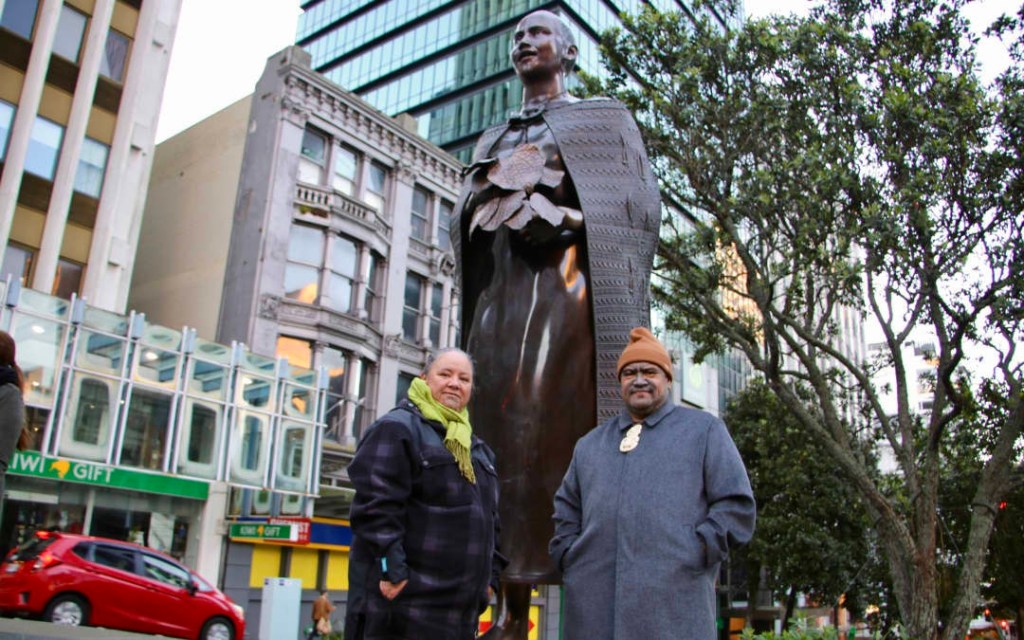
Master carver Arekatera ‘Katz’ Maihi and weaver Beronia Scott.RNZ / Layla Bailey-McDowell
I tārewa ā Ngāti Whātua Ōrakei i ā Wahine i tēnei ata. Nānā i pōhiri atu ki te tini me te mano, hei tohu whakanui i te reo o te wahine, hei hoa hoki mo te koroua e tu ki te taha moana.
Nā RNZ te korero e whai ake nei
Wāhine is a 3.7 metre bronze sculpture of a Māori woman performing a karanga (call of welcome), created by Arekatera ‘Katz’ Maihi and weaver Beronia Scott (Ngāti Whātua Ōrākei).
Maihi (Ngāti Whātua) told RNZ the statue will allow Māori to see themselves in the centre of Auckland.
“It’s important to have this type of mahi in the public spaces because we all hear the current debates around the country, and this is just a total reminder that you can say whatever you want, you can take away what you want, but you’ll never move us. We’re going nowhere, we’re here forever.”
Maihi said since Wāhine will likely be the first thing people see as they exit the new Te Waihorotiu Station he had to incorporate the welcoming process into its design.
“It was all about utilising our practices and our tikanga in these spaces.”
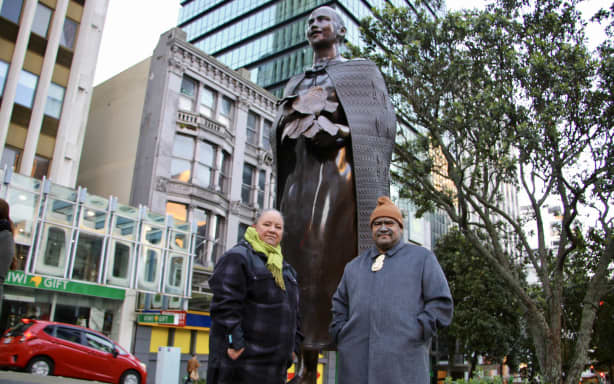
Beronia Scott (Ngāti Whātua Ōrākei) said the inspiration for the korowai (cloak) that Wāhine wears came from a korowai they have at the marae.
“I’ve always been told by master weavers that a korowai is called korowai because of the hukahuka (tassels). A lot of people get that mixed up, they think everything’s korowai, so that’s why I didn’t put anything else on it besides the hukahuka, so that they have to say the right word.”
Maihi said the statue will be a “friend” for the statue that currently stands at Te Komititanga, the public square in front of Waitematā train station, creating an equal balance of tāne and wāhine.
“That also is the reason why I decided I wanted to really acknowledge our wāhine. They’ve been missing from this sort of space.
“I te tuatahi he tohu maumahara, he tohu whakanui ki ngā mahi o ngā wāhine katoa i roto i tō tātau nei hapori o Tāmaki nei. E hoki ake ngā whakaaro ki ngā kuia o mua tae noa ki ēnei rangi, ō mātau nā whaea e mahi ana i ngā mahi.”
“The wāhine artists, Māori, it’s hard to see, hard to find them. So my cousin [was] grabbing me, and I’m very reluctant to do all of this stuff. I’m all good weaving, I’m fine there, I’m all good in that space, but I think wāhine and Māori especially need to be acknowledged,” Scott said.
“She stands on a low plinth, scaled and oriented to meet the gaze of manuhiri (visitors) as they ascend the ramp from the underground station.”
 TOITŪ DESIGN - Outstanding & Enduring Māori Design